

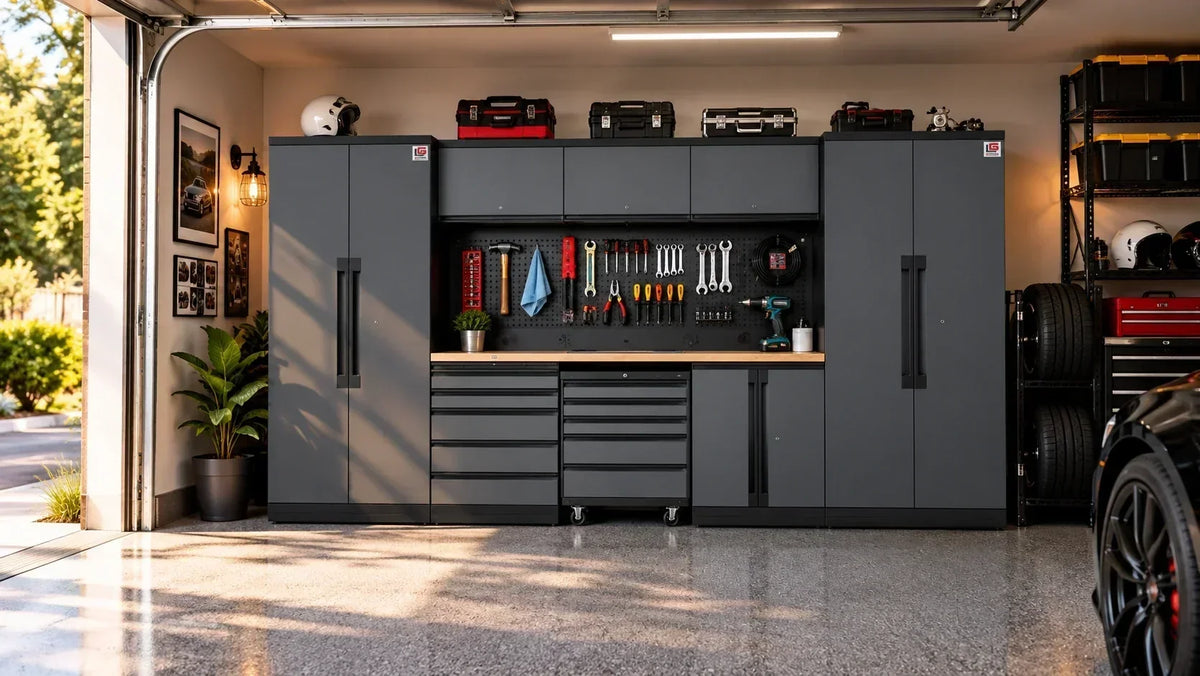
Choosing garage cabinets isn’t just about finding enough storage space. The right cabinet system should fit your garage, support the way you use it, and give you enough flexibility as your storage needs change over time.
Before buying, it helps to look beyond appearance and compare the things that make the biggest difference in everyday use—from cabinet construction and dimensions to worktops, wall storage, installation, and modularity.
Here’s what to consider before choosing a garage cabinet system.
1. Start With What You Need to Store
Before comparing cabinet styles, think about what actually needs a home in your garage.
For some homeowners, that means hand tools, power tools, batteries, and hardware. For others, the garage also stores automotive supplies, detailing equipment, lawn and garden tools, sports gear, or household items.
Different items call for different types of storage.
Drawers make frequently used tools easy to access, while enclosed base and tall cabinets are better suited for larger equipment and supplies you’d rather keep out of sight. Wall cabinets make use of vertical space without taking up additional floor area, and pegboard-style storage can keep frequently used tools within reach.
Instead of asking simply, “How much storage do I need?” consider what you store, how often you use it, and where you want it positioned while you work.
2. Measure Your Garage Before Choosing a Cabinet System
One of the most important steps is also one of the easiest to overlook: measuring the available space.
Start with the width and height of the wall where you plan to install your cabinets, but don’t stop there. Check the depth available as well, particularly if you regularly park vehicles in the garage.
Also account for anything that could interfere with the cabinet layout, including:
- Garage doors and tracks
- Windows and entry doors
- Electrical outlets and switches
- Water heaters, utility panels, and plumbing
- Steps, curbs, or uneven sections of the floor
- Space needed to comfortably open cabinet doors and drawers
It’s also worth thinking about how you move through the garage. A cabinet system may technically fit the wall but still feel too large if it reduces the space around your vehicle or main walkway.
A few careful measurements before buying can prevent a much more expensive problem later.
3. Choose the Right Types of Garage Cabinets
Most complete garage storage systems combine several cabinet types rather than relying on one large cabinet.
Base cabinets provide lower storage and support a work surface. Drawer configurations are particularly useful for tools and smaller equipment.
Wall cabinets add storage above the work area while keeping the floor clear.
Tall cabinets are useful for bulky items and equipment that doesn’t fit comfortably inside standard base cabinets.
Mobile cabinets or carts add flexibility when tools need to move around the garage.
The ideal combination depends on how you use the space. A garage primarily used for storage may benefit from more enclosed cabinets, while a working garage may need more drawers, worktop space, and easily accessible tool storage.
4. Pay Attention to Cabinet Construction
Garage cabinets live in a very different environment from kitchen or indoor furniture.
They may be exposed to heavy tools, frequent opening and closing, dust, temperature changes, moisture, and accidental impacts. Construction quality therefore matters.
When comparing metal garage cabinets, look at the material used for the cabinet body, drawer hardware, hinges, surface coating, and overall assembly.
GarageBaseSystems cabinets, for example, use 1.0 mm cold-rolled steel with a powder-coated finish. Drawers use 45 kg soft-close slides, while gas struts and European-style hinges are used where appropriate throughout the system.
Details like these can make a noticeable difference when cabinets are used regularly rather than simply serving as occasional storage.
5. Consider the Worktop as Part of the System
If you plan to use your garage for repairs, DIY projects, detailing, hobbies, or other hands-on work, the worktop deserves just as much consideration as the cabinets underneath it.
Look at both the available working area and the depth of the worktop. You want enough room to comfortably place tools and materials without making the overall cabinet system unnecessarily deep.
A continuous worktop across multiple base cabinets can also create a much more usable workspace than several disconnected surfaces.
This becomes particularly important when building a modular system, because the cabinets and worktop should work together as one functional station.
6. Don’t Overlook Wall and Pegboard Storage
Not everything belongs inside a drawer.
Frequently used hand tools, accessories, and small equipment are often more convenient when stored where they can be seen and reached immediately.
A pegboard or tool panel between the upper and lower cabinets can turn otherwise unused wall space into functional storage. It also helps separate everyday tools from items that can remain inside cabinets.

The result is a workspace where you don’t have to open multiple drawers every time you need a commonly used tool.
7. Think Modular Instead of Buying for Today Only
Your garage probably won’t stay exactly the same forever.
You may add more tools, start a new hobby, buy another vehicle, or simply discover that you need more storage after using the space for a while.
That’s where a modular garage cabinet system can be particularly useful.
Instead of treating the entire garage setup as one fixed configuration, modular cabinets allow different cabinet types to be combined according to the available space and storage requirements.
You might start with a single storage bay or compact workstation and expand it later. Or you can combine multiple sections from the beginning to create a larger wall-to-wall system.
This approach also makes it easier to choose the cabinet configuration based on your needs rather than forcing your garage to fit a predetermined layout.
8. Consider Installation Before You Buy
A cabinet system can look perfect online and still become frustrating if installation is much more complicated than expected.
Check whether the cabinets arrive fully assembled or require extensive assembly. Also consider the weight of the cabinets and whether you’ll need another person or equipment to position them.
GarageBaseSystems cabinets are pre-assembled, reducing the amount of assembly required after delivery. Depending on the configuration and installation environment, the system can also accommodate different installation approaches.
Because steel garage cabinets can be heavy, it’s still important to plan ahead for unloading and positioning them safely.
9. Compare Warranty and Long-Term Support
Garage storage is usually a long-term purchase, so warranty coverage should be part of the comparison—not something you check only after a problem occurs.
Look at what is actually covered and whether different components have different warranty periods.
For example, GarageBaseSystems provides a limited lifetime warranty on cabinet bodies, along with separate coverage for components such as drawer slides and worktops.
A clearly defined warranty can also give you a better idea of which components the manufacturer expects to remain in service over time.
So, What Should You Look for in a Garage Cabinet?
There isn’t one cabinet configuration that works for every garage.
A better approach is to compare systems based on your storage needs, available dimensions, cabinet construction, workspace requirements, installation preferences, and ability to expand later.
If you mainly need storage, prioritize enclosed cabinet capacity. If your garage doubles as a workshop, consider drawer access, worktop area, and wall-mounted tool organization. And if you expect your setup to change, a modular system gives you more flexibility to adapt over time.
The goal isn’t simply to fill an empty wall with cabinets. It’s to create a garage storage system that makes the space easier to use.
Build a Garage Cabinet System That Fits Your Space
GarageBaseSystems modular cabinets let you combine different upper and lower cabinet configurations to build around your garage, tools, and workflow.
Whether you’re starting with a smaller setup or planning a complete garage wall, you can choose a configuration that fits your available space and expand the system as your needs change.
Explore Modular Garage Cabinets
For larger spaces, you can also explore complete configurations such as the 127" Modular Garage Cabinet System and 154" Modular Garage Cabinet System to compare different system sizes and layouts.
Share:
How to Measure Your Garage for a Cabinet System Before You Buy
What Makes a Quality Garage Cabinet? 7 Features Worth Paying Attention To