

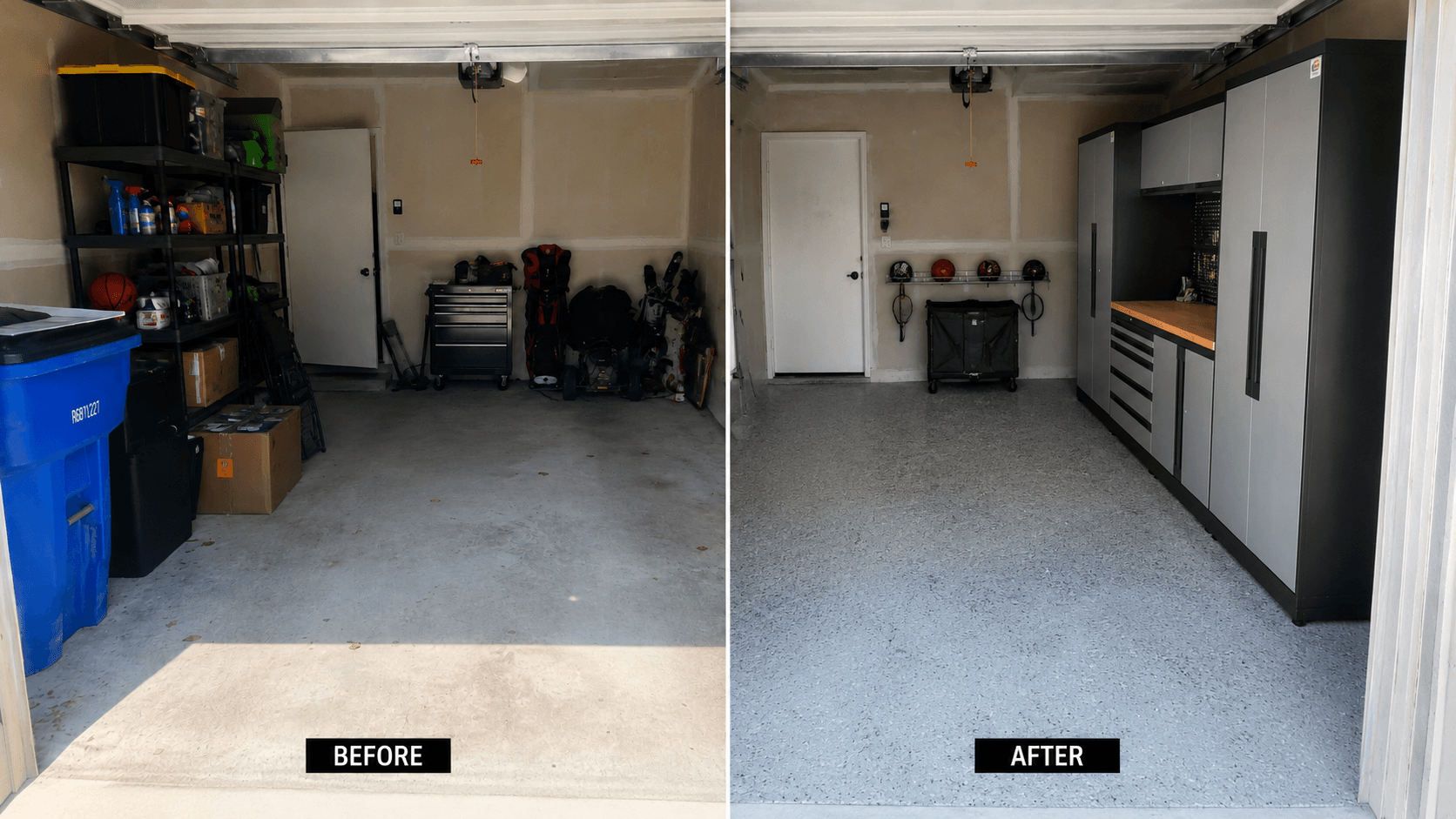
The stack of bins in the corner that had been there since we moved in. The shelving unit from a big-box store that listed slightly to the left, I'd meant to fix it for two years. The toolbox with the broken wheel that I stepped around every time I walked to the car.
None of it bothered me anymore. And that, I've come to realize, is exactly the problem.
A disorganized garage doesn't announce itself. It doesn't break down. It just slowly eats your time, your weekends, and a certain low-grade frustration you carry around without really knowing where it comes from.
The Things You Don't Notice You're Doing
Think about how many times a week you do something like this:
You go to grab a drill bit. You know it's in the garage. You open the door, scan the shelves, move a few things, check behind the Christmas decorations, check the toolbox. You find it eight minutes later, in the exact place you should have put it the first time.
Eight minutes. Twice a week. That's roughly an hour a month gone. Not because you don't have the right tools. Because you don't have the right home for them.
Or this one: you want to start a project on a Saturday morning. Something you've been looking forward to. But first you need to clear some space. So you move some boxes. Rearrange some stuff. Spend twenty minutes making the garage workable before you've done a single thing you actually wanted to do.
That tax is invisible. You pay it so regularly it doesn't feel like a cost anymore. It just feels like how garages work.
What Clutter Actually Does to a Garage
A cluttered garage isn't just inconvenient. It changes how you feel about the space and whether you use it at all.
Most people with messy garages start avoiding them. The car gets parked on the street because the garage is too full. The woodworking project gets postponed because setting up takes too long. The workout equipment collects dust because getting to it requires moving four other things first.
The garage becomes a room you store problems in rather than a room you actually use.
What's worse is that the clutter expands to fill the space. Without a defined system, stuff gravitates toward any available surface. Shelves fill. Corners fill. The floor fills.
The Lie of "I Just Need More Space"
The first instinct when a garage gets out of hand is usually to wish for a bigger one.
But more square footage is rarely the answer. More square footage without organization just becomes more square footage of clutter. The real issue is almost never the amount of space it's the absence of a system for using the space you have.
Think about it this way: every tool you own has to live somewhere. Either you decide where that is, or it decides for you. When you decide when every socket wrench has a drawer, every paint can has a shelf, every power tool has a spot it goes back to the garage starts working for you instead of against you.
That shift isn't just functional. It's psychological. People describe the feeling of a properly organized garage the way they describe a clean kitchen counter, a kind of mental quiet that's hard to put into words until you've experienced it.
Starting Small Is Fine. Starting Is the Point.
Here's the thing about a garage overhaul, it doesn't have to be everything at once.
A lot of people put it off because they're imagining a weekend-long project, a dumpster rental, a full rebuild. And sometimes it is that. But often, the first step is just deciding that you're not going to keep getting used to it.
The Kronos system, GarageBase Systems' 17-piece entry-level setup was designed specifically for the single-car garage that needs a real foundation. Not a partial fix, not a shelf here and a hook there, but a complete system: two tall standing cabinets, wall storage above, drawers below, a workbench in the middle. Everything assigned. Everything in its place.
It fits in approximately 10.6 feet of wall space. It installs in a few hours. And it covers the one thing that makes the biggest difference giving every category of thing you own a permanent, defined home.
You don't have to do everything at once. But the sooner you stop getting used to the mess, the sooner the garage starts feeling like a room worth being in.
The Real Cost of Waiting
The garage stays the way it is. You keep stepping around the toolbox with the broken wheel. You keep losing twenty minutes on Saturday mornings.
And that's fine. Plenty of people do exactly that, for years.
But if you've ever stood in a well-organized garage, maybe at a neighbor's place, or a shop you visited and felt that faint pang of wanting that for your own space, you know the feeling doesn't go away. It just gets quieter until something reminds you of it again.
The frustration of a bad garage isn't dramatic. It's just steady frustration, paid out in small amounts every week, adds up to a lot by the end of a year.
At some point, fixing it stops being a luxury and just becomes the obvious thing to do.
Ready to stop stepping around the problem? Start with the Kronos 17-piece system, the complete foundation for a garage that actually works. Or compare all systems at here.
Share:
Why Heavy-Duty Garage Cabinets Are Worth the Investment
Metal Garage Cabinets: What Every Homeowner Should Know